

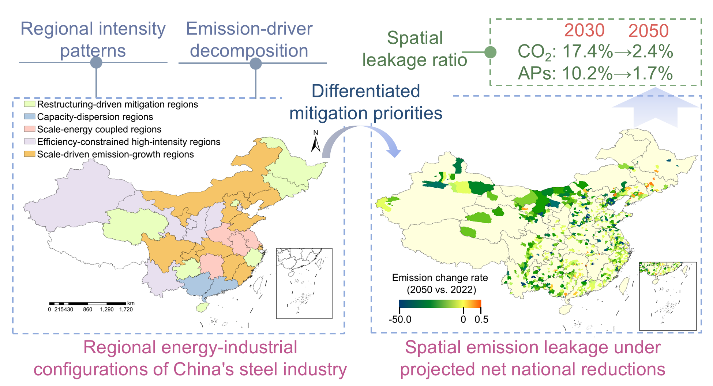
Recently, Jinping Cheng’s research group from the School of Environmental Science and Engineering at Shanghai Jiao Tong University published a research article entitled “Coupled Energy-Industrial Transitions Shape Heterogeneous Carbon-Air Pollution Cobenefits and Spatial Emission Leakage in China’s Steel Industry” in Environmental Science & Technology. Using a unit-level emission database covering 2,866 enterprises and approximately 4,030 production units, the study revealed how regional energy-industrial configurations shape heterogeneous carbon-air pollution cobenefits and mitigation priorities. During 2023–2050, production restraint is projected to contribute the largest cumulative CO2 reduction (22.1%), whereas obsolete capacity retirement dominates air-pollutant reductions (22.31%). Notably, under regionally differentiated transition pathways, net emission reductions nationwide may coexist with localized emission increases and a spatial redistribution of emission burdens, thereby giving rise to spatial emission leakage. The corresponding CO2 leakage ratio is projected to decline from 17.39% in 2030 to 2.38% in 2050. These findings support sequenced, region-specific pathways that combine the upgrading of existing long-process capacity with the gradual expansion of short-process steelmaking.
https://doi.org/10.1021/acs.est.6c08461